
Which Palo Alto Directory Fits
The strongest Palo Alto people directories are kept by the institution that created each relationship. City lists identify departments and senior officials. PAUSD and Stanford directories cover education ties. County indexes connect names with fictitious businesses and recorded documents, while property tools begin with an address or assessor parcel number, known as an APN. Libraries and historical groups carry the deepest coverage for former residents.
| Directory Source | People or Entries Listed | Responsible Keeper | Way to Search |
|---|---|---|---|
| Palo Alto Phone Directory and team pages | City functions, departments, and named officials | City of Palo Alto | A-Z tabs, search, and open web pages |
| PAUSD staff directories | District and school staff | Palo Alto Unified School District | Keyword, first name, and last name |
| StanfordWho and Stanford Profiles | University affiliates and public research profiles | Stanford University | Public search, with visibility limits |
| California Personnel Office Directory | State personnel-office contacts | California State Controller | A-Z agency browsing |
| FBN and professional registrations | Business registrants and registered professionals | Santa Clara County Clerk-Recorder | Self-service portal and county counter |
| Assessor and recorder records | Parcel details and parties to recorded documents | Santa Clara County | Address/APN online, then office research |
| City directories and obituary files | Past residents, occupations, addresses, and family notices | Libraries and historical groups | Online index, print, archive, and microfilm |
Start with an institution when the connection is current. Use the city or school search for a public contact, Stanford sources for a university affiliation, and business or license records for a trade name. For a past address or former resident, the Palo Alto Library and regional collections are more useful than a modern staff list. Formal access rules and copy procedures belong with Palo Alto public records access.
Palo Alto Civic Directory Entries
The Palo Alto Phone Directory is arranged around public functions. It has A-Z tabs and a search tab, and an entry may show the function, department, street address, phone, fax, email, hours, and notes. The City Manager's team page adds named senior officials. Planning and Development Services also groups staff by building, planning, and code-enforcement units, which helps when a person's city role is known but a direct contact is not.
- Entry name: a function, department, or named official.
- Role: a title or unit that explains the city connection.
- Work contact: a public phone, email, fax, or main office line when posted.
- Place: an office or service address where the directory supplies one.
- Extra detail: hours, service notes, or an emergency contact for some functions.
The City Manager team directory shows how named entries appear in the live Palo Alto people directory.
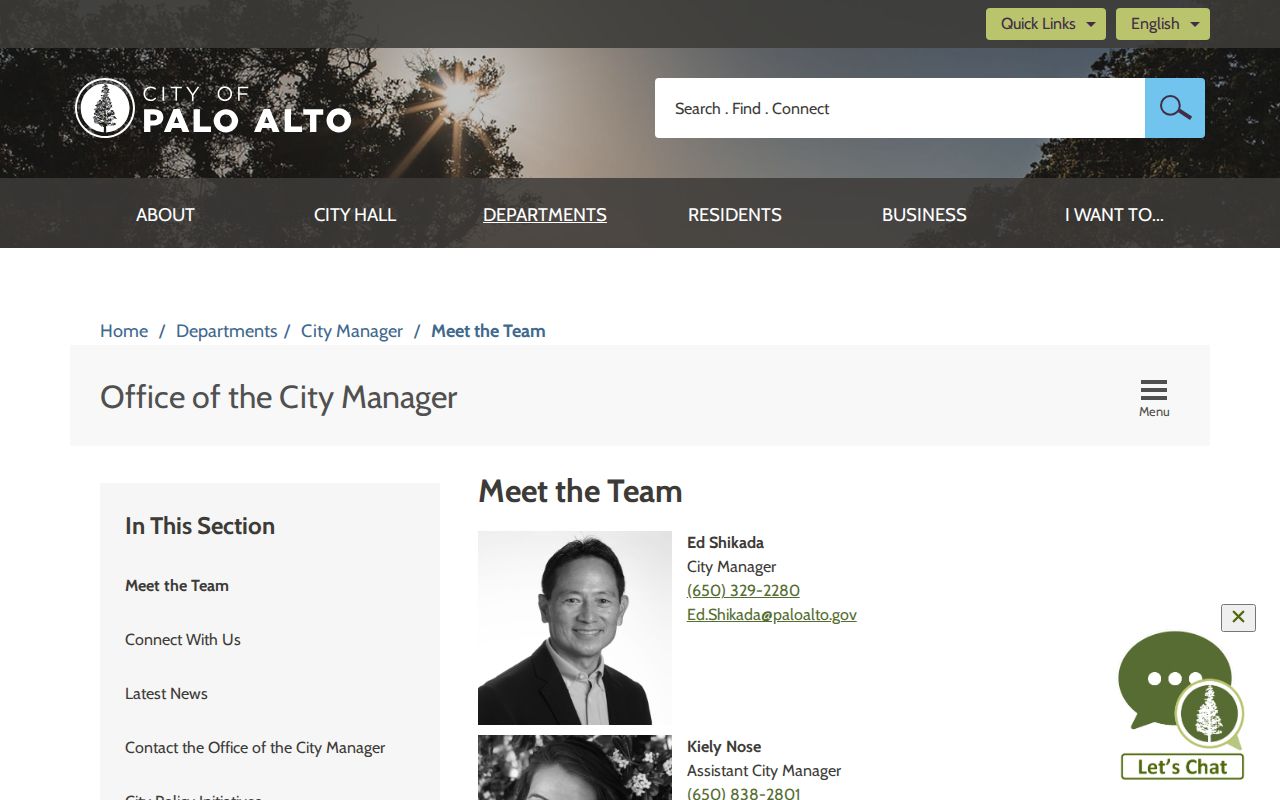
That view makes the difference between a function-only phone book and a named staff record clear: a team entry can pair a full name with a title, work phone, and public email. If no named result appears, call the listed department. The City Clerk also accepts records requests through GovQA, email, mail, phone, and in person when an existing public roster or record is needed.
Search Palo Alto School Directories
PAUSD people directories are split between district pages and individual school sites. Central pages name administrators by department, while school directories can be searched directly. The California Department of Education district record supplies another official contact layer, including the superintendent, chief business official, district address, phone, fax, email, and website.
| Search Field | Control | Required | How It Works |
|---|---|---|---|
| Keyword | Text | No | Searches words within staff entries |
| First Name | Text | No | Narrows the directory by given name |
| Last Name | Text | No | Narrows results by family name |
The result inventory is concise: a staff member's full name and role title. Some PAUSD pages instead group names under departments and display Name and Title columns. Try a last name alone when the spelling is sound, then use a keyword tied to a role or department if several people share that name.
The PAUSD school staff search displays the directory fields used for these filters.
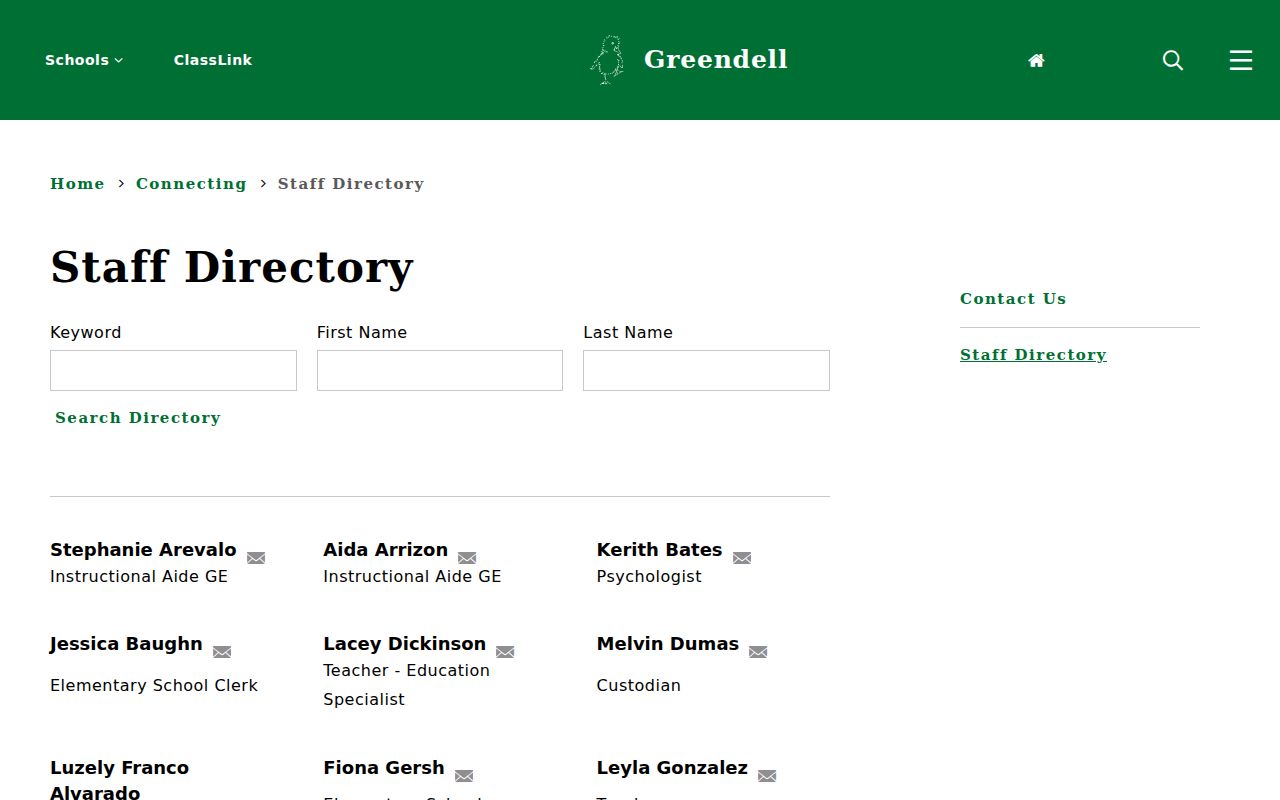
The captured screen confirms that users can combine keyword, first-name, and last-name filters rather than scan one long Palo Alto directory.
Stanford and Palo Alto Directories
Stanford's place in Palo Alto makes university directories a key parallel track. StanfordWho searches by name, nickname, email, work phone, or SUNet ID. It covers current students and postdoctoral scholars, faculty, several staff groups, and sponsored affiliates. Yet the public view includes only people who choose public visibility. A signed-in Stanford view may show more people and organization links, so a missing public result does not prove that no affiliation exists.
Stanford Profiles has a different purpose. Its public profiles can add expertise, biography, research, publications, and contact details for faculty, staff, students, and postdoctoral scholars. StanfordWho may answer whether a visible current affiliate matches a name, while Profiles can distinguish two similar names through department and research context. Alumni who have passed the directory's grace period use a separate alumni system, and current hospital staff are not part of StanfordWho's public directory population.
California Directories for Palo Alto
The State Controller maintains two useful public directory systems. The California Personnel Office Directory supports A-Z browsing of state departments, campuses, and personnel offices. Entries can include a contact name, phone, email, mailing or street address, and agency code. It is best used when the state agency is known. Government Compensation in California is a separate search organized around public employer, position title, reports, and downloadable data.
The state personnel directory browse screen shows the agency-led path used for Palo Alto directory research.
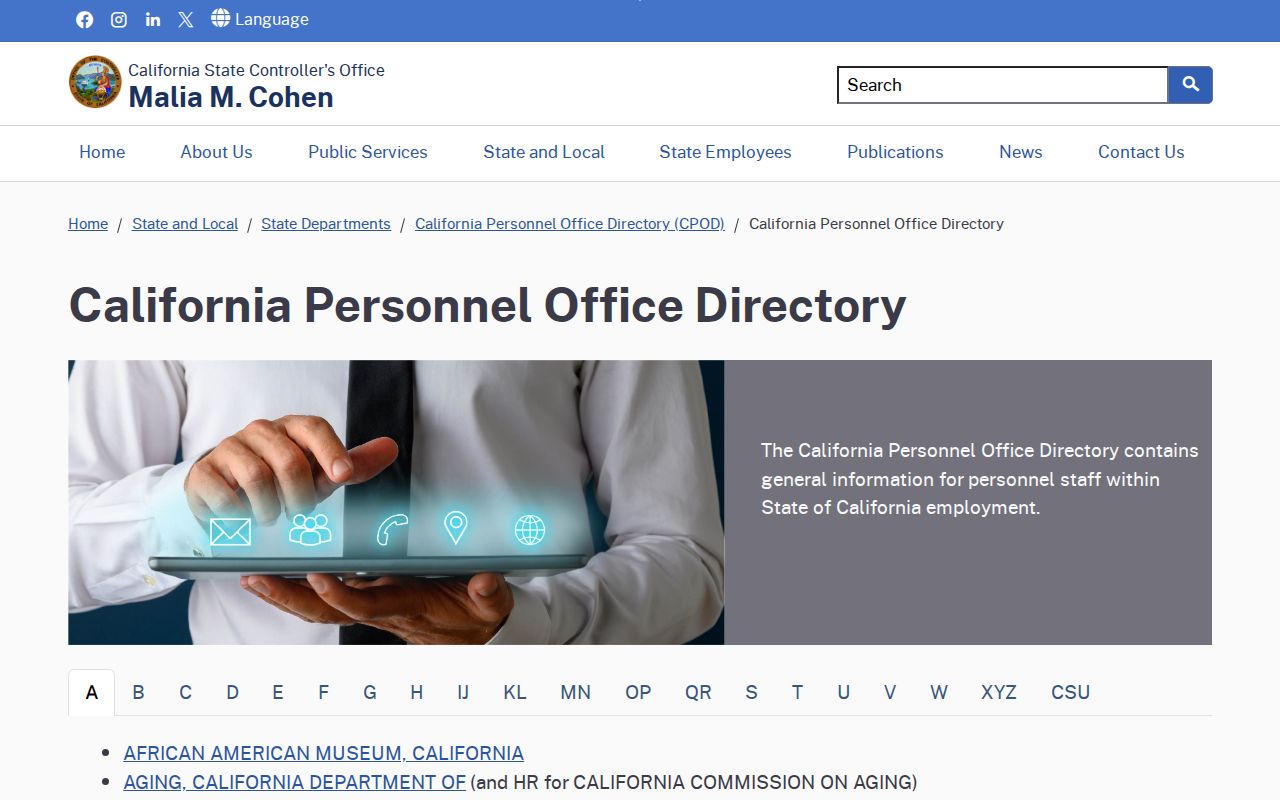
This directory is not a general resident list. It works when a Palo Alto connection points to a California office or campus and an agency name can narrow the search.
Palo Alto Records as Directories
Some official records work like directories even though they were created for another task. Santa Clara County's Fictitious Business Name search can use business name, registrant name, filing number, or a filing-date range. Advanced name options support broader spelling searches. The professional registration portal searches an individual or firm name, filing dates, filing number, and document types such as notary public, process server, professional photocopier, and legal document assistant.
Recorded documents form another name index, but access is not fully online. The Clerk-Recorder directs real-estate researchers to its San Jose office and permits searches by name, document number, or book and page. Digital Reel at the office covers maps and documents recorded from 1850 through 1980. Copies may be requested in person, by email, or by mail once the document number or book and page is known. The county does not search the recorder index by street address or APN.
Voter data is not an open Palo Alto people directory. California limits voter-file recipients and uses. A voter may check personal registration through official county or state tools, but those systems should not be treated as public name browsers.
Note: Search spelling variants in the county portal because its index works like a catalog, and entries may change as records are corrected.
Palo Alto Address Directory Limits
The Santa Clara County Assessor Real Property Search accepts an address, APN, or map search and can return the property address, mailing address, document number, parcel map, assessed value, and other parcel details. It does not allow an online owner-name search and does not show individual owner names. That limit prevents the portal from serving as a simple owner directory.
For address-led research, combine the Assessor with Palo Alto Permit View, the city's Online Parcel Report, or the county Property Explorer. Permit View searches building, planning, and code activity by property address, APN, date, application type, or a custom area. Assessor computers and microfiche remain available in person. The office also has a two-year transfer and sales-price list, for a nominal fee plus copy charges, with buyer, seller, APN, property address, dates, document number, and indicated price.
- APN
- The Assessor's parcel number used to identify a piece of real property.
- Situs address
- The physical location of the parcel.
- Mailing address
- The destination for tax or owner correspondence, which may differ from the property.
- Document number
- The recorder's identifier used to locate and order a recorded instrument.
Palo Alto Business Name Directories
Business and professional people directories answer different questions. The Palo Alto Business Registry searches a local business name, address, or business type. The county FBN index connects a trade name to its registrant. California Secretary of State bizfile covers corporations, limited liability companies, and limited partnerships, with status, filings, agent and address data, and public filing PDFs.
The California Department of Consumer Affairs License Search accepts first name, last name, license number, business name, registry number, and board or bureau. Results can show whether a license is current, expired, suspended, or revoked. Board-specific sources, including the State Bar and contractor, medical, nursing, real-estate, and credential systems, can add the profession and license status needed to separate people with similar names.
Use the narrowest fact first. A license number beats a common name. A Palo Alto street can narrow a business registry result, while an FBN filing number goes straight to a county entry. Exact fields for dynamic systems may change, so rely on the labels shown by the official search.
Historic Palo Alto Directory Years
Printed Palo Alto directories can identify a resident, residence, and occupation. Stanford Historical Society lists Palo Alto Public Library holdings for 1895, 1895/96, 1901/02, 1902, 1905/06, 1912/13, 1940, 1941, 1942, 1948, 1950, 1953, 1955, 1957, 1959/60, 1962, 1963, 1965, and 1968 under call number 979.473 P769p. Ask at the desk. The same source says no Palo Alto directories were published in 1943 or 1945, so those missing years are not proof that a resident left.
| Collection | Palo Alto Coverage | What It Adds | Access |
|---|---|---|---|
| Palo Alto City Library | Selected issues, 1895 through 1968 | Resident, address, and occupation | Ask at library desk |
| San Jose Public Library California Room | Palo Alto, 1938 through 1978 | City directories, phone books, Haines Criss Cross | Library collection |
| Stanford Historical Society references | Palo Alto and environs, 1895/96 through 1978 | City and Stanford directory bibliography | Online holdings list |
| History San Jose | San Jose and selected county areas, 1870 through 1979 | Names, residence, occupation, and regional context | Research library |
Stanford Historical Society's references also list Stanford alumni directories for 1910, 1931, 1955, and 1984, plus university directories reaching from the 1891/92 register era into the modern Stanford Directory. These volumes fill an institutional track that city books may miss.
Reverse or criss-cross directories arrange entries by street and house number instead of name. They are useful after finding an old address in a letter, deed, or obituary. Read the front matter because abbreviations and street numbers may have changed. A sequence of nearby years can reveal when a household first appeared or vanished, but the wartime publication gaps must remain part of that judgment.
- City directory
- A printed name list that can pair a resident with an address and occupation.
- Reverse directory
- A street-led book used to identify people listed at a known address.
- Coverage gap
- A year with no published issue, such as Palo Alto's documented 1943 and 1945 gaps.
Mayfield Names in Palo Alto
Mayfield was annexed to Palo Alto in 1925. A resident from before that year may be filed under Mayfield, not Palo Alto, in a newspaper or city directory. The Palo Alto Library's Historical Newspaper Collection includes the Mayfield Enterprise from 1870 to 1871, along with later Palo Alto papers. Its full text can be searched by keyword, name, place, and publication year. Original local newspaper microfilm and physical local-interest collections are housed at Rinconada Library.
The Palo Alto Library genealogy and local-history collection also links the Obituary Index, local news resources, HeritageQuest, and AncestryLibrary. HeritageQuest is available with a library card, while AncestryLibrary is for in-library use. If online text does not settle an identity, use the cited issue on microfilm and check nearby dates for family names, addresses, and organizations.
Note: Try both Mayfield and Palo Alto as place terms for people who lived locally before annexation or during the transition.
Palo Alto Obituary Directories
The Palo Alto Historical Association says its archive contains more than 30,000 obituaries from the 1890s to the present. Coverage includes Palo Alto residents as well as Stanford faculty, staff, and students. Its wider archive preserves local publications, organizational and business records, oral histories, images, and other community material. Those sources can connect a person with relatives, clubs, a business, or an institution that ordinary name directories omit.
Regional fallback channels add depth. History San Jose keeps biographical clippings, family-history files, subject files, business cards alphabetized by company or person, and oral histories. The California State Archives lists Santa Clara County probate, wills, early vital records, marriages, declarations of intention, and an obituary index. The county Naturalization Index covers 8,000 individuals from 1850 through 1934 and may show name, nationality, admission date, court, and book/page.
Local archive research can begin online, then move to a library desk, microfilm reader, historical association archive, or county and state reference service. Bring name variants and an estimated date. A directory year, newspaper notice, and archive reference together offer a sounder identification than any one entry alone.