
Palo Alto Open Records Inventory
No single office keeps every Palo Alto public record. City Hall holds municipal files, permits, agendas, and disclosures. Santa Clara County offices in San Jose hold the main deed, property, vital, and election systems. The Superior Court maintains case indexes and court files. Each row below distinguishes an online finding aid from the actual record. An index may identify a file but still require a counter visit or copy order.
| Record group | Keeper | Web access | How access works |
|---|---|---|---|
| City agendas, ordinances, comments | Palo Alto City Clerk | Records Portal | Search, browse, preview, or file a CPRA request |
| Permits and code activity | Palo Alto PDS | Permit View and ACA | Address, APN, date, type, or geographic area |
| Deeds, liens, maps | Santa Clara Clerk-Recorder | Limited self-service | In-person research is primary; copies by counter, email, or mail |
| Property roll | Santa Clara Assessor | Real Property Search | Address, APN, or map; individual owner names hidden online |
| Court cases | Santa Clara Superior Court | Case Information Portal | Indexes online; documents often at terminals or by copy request |
| Birth, death, marriage | Clerk-Recorder; CDPH | No routine name index | Authorized or informational copy rules apply |
| Police and custody | Palo Alto Police; Sheriff; CDCR | Logs and custody lookups | Release limits depend on record and status |
California does not make every government-held detail open. Sealed or expunged cases, juvenile and adoption files, confidential marriages, protected voter data, motor-vehicle data, and sensitive identifiers are restricted. Even an open record may have redactions. A request therefore works best when it names a specific file rather than seeking all facts about a person.
Palo Alto City Records Channels
The City Clerk's records hub points to agendas, minutes, ordinances, resolutions, public comments, and public-official filings. Its Records Portal supports predefined searches, keyword searching, browse views by document type, committee, year, or number, and document previews. Form 700 financial-interest disclosures and campaign forms such as Forms 410 and 460 are kept in the city's separate eFile system.
When the item is not already posted, the Palo Alto public-record request page accepts submissions through GovQA, email, mail, phone, and in person. A useful request states the date range, likely department, record type, and keywords. Do not place confidential facts in the request itself. Police records follow a separate path through the Police Department Records Unit and its GovQA portal.
City meeting files can reveal names in board rosters, contracts, public letters, and official disclosures. They are civic records, not proof that every name or statement in them is current. Use the file date and source department when citing a result.
Note: Posted agendas, minutes, municipal code, ordinances, resolutions, and budgets may answer a question before a custom city request is needed.
Palo Alto Permit Records Update
Palo Alto's Permit View searches building, planning, and code-enforcement activity by property address, date, application type, APN, or a custom geographic area. The system replaced BuildingEye, which the city planned to discontinue at the end of 2025, while added features were scheduled through 2026. Map alerts require an account, but viewing can begin after accepting the user agreement.
The Accela Citizen Access portal provides another permit-history route without a login. Its service menu separates building, planning, fire, public works, and miscellaneous records, and it supports permit and inspection tasks. This view of the Palo Alto ACA menu shows how record types are divided before a search begins.
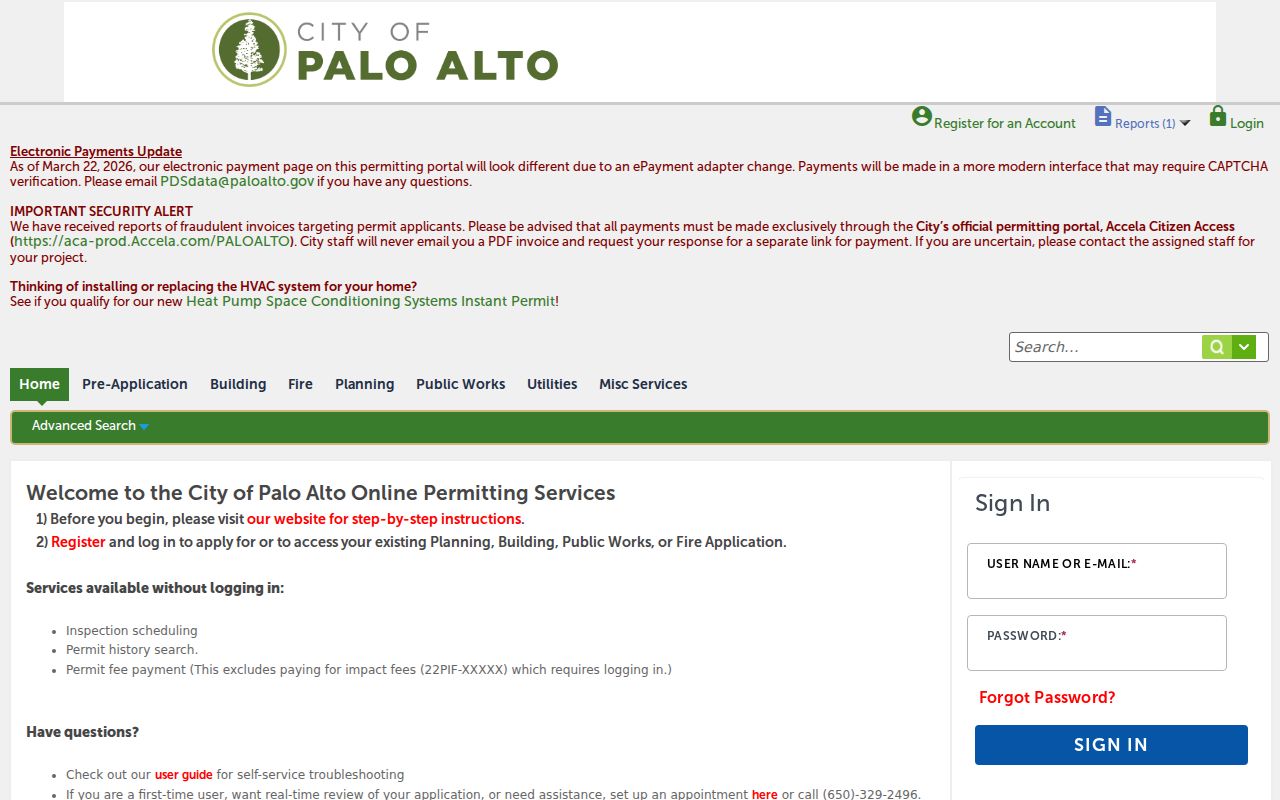
The menu is important because a planning record and a building record may sit under different tabs even when both concern the same address. Permit identifiers such as a Building pre-application or official Building Permit also provide a sharper request key than a broad owner-name query.
Palo Alto Records Offices Nearby
Palo Alto is not the county seat. The main Santa Clara County public records counters are in San Jose, so a search that begins with a Palo Alto address may lead south to a county office. Confirm the office and channel before traveling.
Santa Clara Clerk-Recorder
110 W. Tasman Drive, 1st Floor
San Jose, CA 95134
(408) 299-5688
Palo Alto City Clerk
250 Hamilton Avenue, 7th Floor
Palo Alto, CA 94301
(650) 329-2571
Clerk-Recorder counter hours are generally weekdays from 8:00 a.m. to 4:30 p.m.; Assessor office hours are generally weekdays from 8:00 a.m. to 5:00 p.m. The Palo Alto Courthouse handles local criminal matters, while civil and probate files may lead to other Santa Clara Superior Court locations.
Palo Alto Deed Records Offline
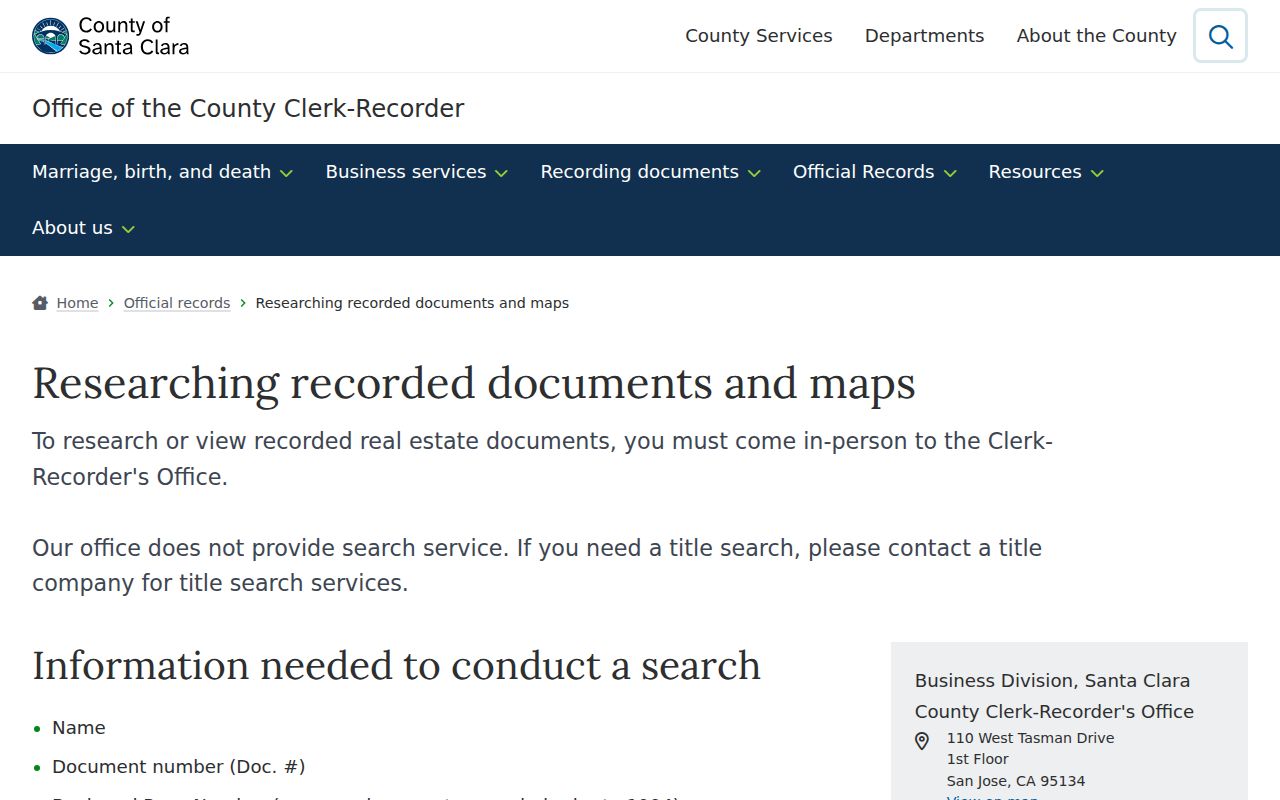
Real-estate document research is not fully online in Santa Clara County. The official recorder research instructions direct people to the Clerk-Recorder office to research or view deeds, liens, and maps. The office does not perform title searches. Counter searches use a name, document number, or a book and page for maps and many pre-1994 documents. Digital Reel provides maps and documents recorded from 1850 through 1980.
The official page shown below makes the in-person rule and search limits visible. It also explains why a Palo Alto street address or assessor parcel number, called an APN, will not work as a search key in the recorder index.
For copies, first obtain the instrument number or book and page. Orders may be made at office kiosks, by email to bus-rdc@rec.sccgov.org, or by mail to the Business Division at the Tasman Drive address. Copies cost $4 for the first page and $2 for each added page, plus $2 for certification. Official records are not sent electronically, and processing can take up to seven business days.
Local deed cost detail. Palo Alto's city conveyance tax is $1.65 per $500 in addition to Santa Clara County's documentary transfer tax of $0.55 per $500.
Palo Alto Property Record Limits
The county Assessor gives online access by APN, the first characters of a property address, or map. It shows assessed value, property and mailing addresses, document number, parcel maps, and other property facts. Ownership changes are updated weekly, while values reflect the latest annual assessment-roll close. The key limit is firm: the web system does not allow an owner-name search or display individual owner names.
| Search control | Format or option | Public result limit |
|---|---|---|
| APN | With or without dashes | Parcel facts, not owner name |
| Property address | First few characters accepted | Situs and mailing data may appear |
| Map search | Interactive parcel map | Parcel-based results |
| Owner name | Not offered online | Individual names withheld |
The offline channels add depth. Assessor office computers and microfiche are available, and an in-office transfer list covers the prior two years. That list can include buyer, seller, APN, property address, land use, transfer and recording dates, document number, and indicated price for a nominal fee plus copy charges. The County Property Explorer and Palo Alto Online Parcel Report supply more map context.
Note: Use the Assessor to obtain a document number before asking the Clerk-Recorder for a deed copy tied to a Palo Alto address.
Palo Alto Court Record Access
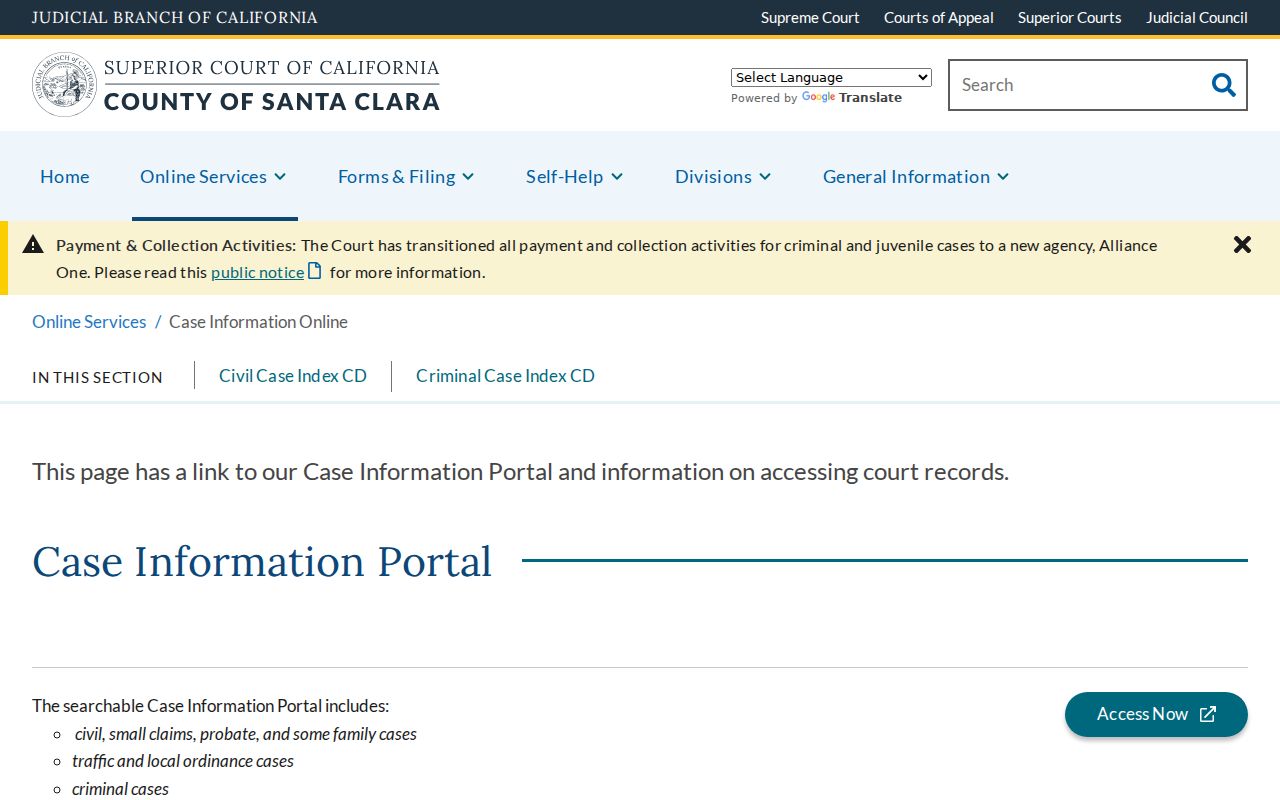
The Santa Clara Superior Court information page covers civil, small claims, probate, some family, traffic and local ordinance, and criminal cases. Its Case Information Portal is an index and case-information route, not a complete online document library. Public documents may instead be viewed on courthouse terminals or ordered from the clerk.
The court's own access page, shown here, describes portal coverage, copies, and record limits. Criminal cases filed in 2004 or later can be searched by defendant name with date of birth, or by name with the filing month and year. Pre-2004 criminal searches use courthouse microfiche with name, birth date, and filing year.
Copy requests work best with the case number, full party names, document titles, and filing dates. Clerk copies cost $0.50 per page. A mail request should include a self-addressed stamped envelope and a check payable to the Superior Court; the court suggests a not-to-exceed amount when the final fee is unknown. As of January 1, 2026, AB 1524 permits eligible public viewers to photograph certain paper records and terminal-displayed electronic records, subject to facility rules and all confidentiality limits.
Palo Alto Vital Record Copies
Santa Clara County Clerk-Recorder holds county birth and death records from 1873 forward and marriage records for county-issued licenses from 1850 forward. These are copy services, not a routine online name index. California Health and Safety Code section 103526 controls authorized certified copies. A person outside an authorized class may generally receive an informational copy marked as not valid to establish identity. A confidential marriage certificate is limited to a party or a court order.
County fees are $34 for an in-person birth certificate, $26 for an in-person death certificate, and $19 for a certified marriage copy when paid by cash or check as applicable. Card prices for birth and death copies are higher. The California Department of Public Health is the statewide mail fallback, though its published average for certified copies is five to seven weeks and the county may be faster.
Divorce files are different. The Clerk-Recorder does not hold the decree or full divorce case. Those records belong to Santa Clara Superior Court and remain subject to court access rules. This distinction prevents a wasted vital-record order when the needed document is a court judgment.
Palo Alto Police Records Routes
The Palo Alto Police report log provides the last 30 business days of public entries. Fields can include case number, date, time, offense, location, and arrestee information. Juveniles appear only as “Juvenile,” and protected incident categories omit specific locations. Older logs are removed under the stated retention rule.
For a report not answered by the log, use the Police Records Unit request channel, GovQA, mail, or the records counter. Requests are reviewed case by case, proof of identity may be required, and release can depend on the requester's legal status. The city's GovQA information lists no charge to make a request and $0.13 per page for current physical-copy charges; electronic compilation may create other costs after staff contact.
Custody tools answer a narrower question. The Santa Clara Sheriff search concerns people now in county custody, while California's CIRIS concerns current state custody. The Megan's Law registry publishes only legally disclosable information and carries strict anti-harassment rules. A matching name alone is not enough to confirm identity.
Palo Alto Records Terms Decoded
Records offices use short terms that describe access, not just content. Knowing them helps a Palo Alto request reach the right source and avoids paying for the wrong product.
- Index
- A finding aid listing facts such as names, dates, or a document number. It is not necessarily the filed image.
- Certified copy
- A copy authenticated by the custodian for an added fee. It differs from a plain viewing or informational copy.
- Custodian
- The agency or office responsible for keeping and responding for a particular record.
- Exemption
- A legal basis for withholding all or part of a government record.
- APN
- The Assessor's parcel number used to identify land in property systems.
A record may be indexed online but unavailable as an image. That is common in Santa Clara court and recorder systems. Conversely, an agency may hold an image but need a document number, case number, or book and page before it can fulfill the copy request.
Closed Palo Alto Record Details
Public access has firm boundaries. Court rules restrict remote access to many criminal, family, juvenile, guardianship, mental-health, harassment, and protective-order matters. Sealed and adoption records stay outside ordinary public access. Arrest reports, victim contact details, probation reports, medical facts, and criminal-history data can also be withheld even when a case index is visible.
Property files hide some personal fields online. Vital offices separate authorized certified copies from informational copies. Voter registration is not a general public directory, and confidential voters receive added protections. California Safe at Home gives eligible survivors a substitute-address and confidentiality program, while motor-vehicle records remain outside the normal people-record trail.
Redaction does not mean the whole agency database is secret. It means the office must apply the relevant law to the record and requester. Ask for the segregable, non-exempt portion when a file contains both open and protected material.
Note: A portal result confirms that an index entry exists; it does not override identity checks, sealing orders, or copy eligibility rules.
Request Palo Alto Public Records
The California Public Records Act applies to reasonably described, non-exempt state and local records. Government Code section 7922.530 calls for prompt access upon payment of direct duplication costs or a statutory fee. Section 7922.535 gives an agency 10 days to determine whether it holds disclosable records and to state an estimated availability date. Written notice may add up to 14 days for unusual circumstances. That determination period is not a promise that every record will be produced within 10 days.
- Identify the custodian. Send city records to the Palo Alto department, court files to the clerk, and county records to the appropriate county office.
- Check the posted portal or index. Save the case, permit, document, or parcel number that will narrow the request.
- Describe the record, date range, subject, and likely department. Use GovQA, email, mail, phone, or an in-person channel offered by that keeper.
- Choose inspection, a plain copy, or a certified copy. Ask for a fee estimate before work that could create a charge.
- If access is denied, ask for the exemption and whether a narrower request can release a segregable portion. CPRA disputes can ultimately be reviewed in court.
A precise request is easier to search. For example, a date range plus a council body and document type is better than asking for every city file about a name. Likewise, a recorder copy order needs an instrument number or book and page, while a court copy request benefits from a case number and document title.
Lawful personal use. Use Palo Alto public records for legitimate research and civic purposes. Never use a record to stalk, harass, threaten, or harm another person.